Section 3.2 Saving Money on Groceries
Subsection 3.2.1 Cooking vs. Eating Out
Here’s an interesting question. Which is cheaper: eating out of cooking yourself? The answer actually depends. Let’s suppose you would like one hamburger and french fries. Suppose the burger will be 1/3 lb with lettuce, tomato, and mayonnaise. At a restaurant in the Westfield area, a burger and fries will cost about $12 - $17 plus tax and tip. So, about $15-$22. If you go to fast food (e.g. Five Guys or Burger King), you’re looking at a similar price minus tip. So, about $13-$16. If you want to make it yourself, you need ingredients. This is where things get really variable.
Suppose you have no ingredients needed. Ground beef is about $6/lb, sold in quantities of about 1.25 lbs. So, $7.50. A head of iceberg lettuce is about $2.50. One tomato will be about $1. A bottle of mayonnaise is about $4. A package of hamburger buns is about $4. A bag of french fries is about $4. Canisters of salt and pepper to season the burger will be about $5. So, everything together will be about $28 to cook yourself a hamburger and fries.
However, let’s suppose you have a group of four people who will each get a hamburger and fries. Eating a restaurant will yield a bill of about $60-$80. Fast food will be $52-$64. However, the grocery price won’t change. It’s $28 because you’ll have enough with the ingredients to make four services. So, it works out to be $7 per person.
In general, it is cheaper to cook at home when there are multiple people eating. However, cooking for just yourself can be a bit precarious, price-wise. That $28 for a burger and fries looks pretty daunting. The thing is, that $28 was based on the assumption that you had no ingredients. Suppose instead that you previous bought beef and french fries and froze what you didn’t use and already had items that can be stored like mayonnaise, salt, and pepper. Then you just need buns, lettuce, and tomato, which would run you about $7.50, which is a good deal cheaper than eating out.
So, a general rule is that, over all, it is cheaper to cook yourself if you are prudent with saving ingredients.
Subsection 3.2.2 Activity: Why Do You Eat Out?
For this activity, list the two biggest or most frequent reasons that you go somewhere to eat. (Restaurants, fast food, etc. The Dining Commons doesn’t count as eating out.) For each reason, come up with a way your could satisfy that reason while still cooking at home or in a dorm kitchen. If it is impossible to satisfy a reason to go out at home, say why.
Subsection 3.2.3 Buying in Bulk
Here is a general rule of grocery shopping.
It is cheaper to larger quantities of food.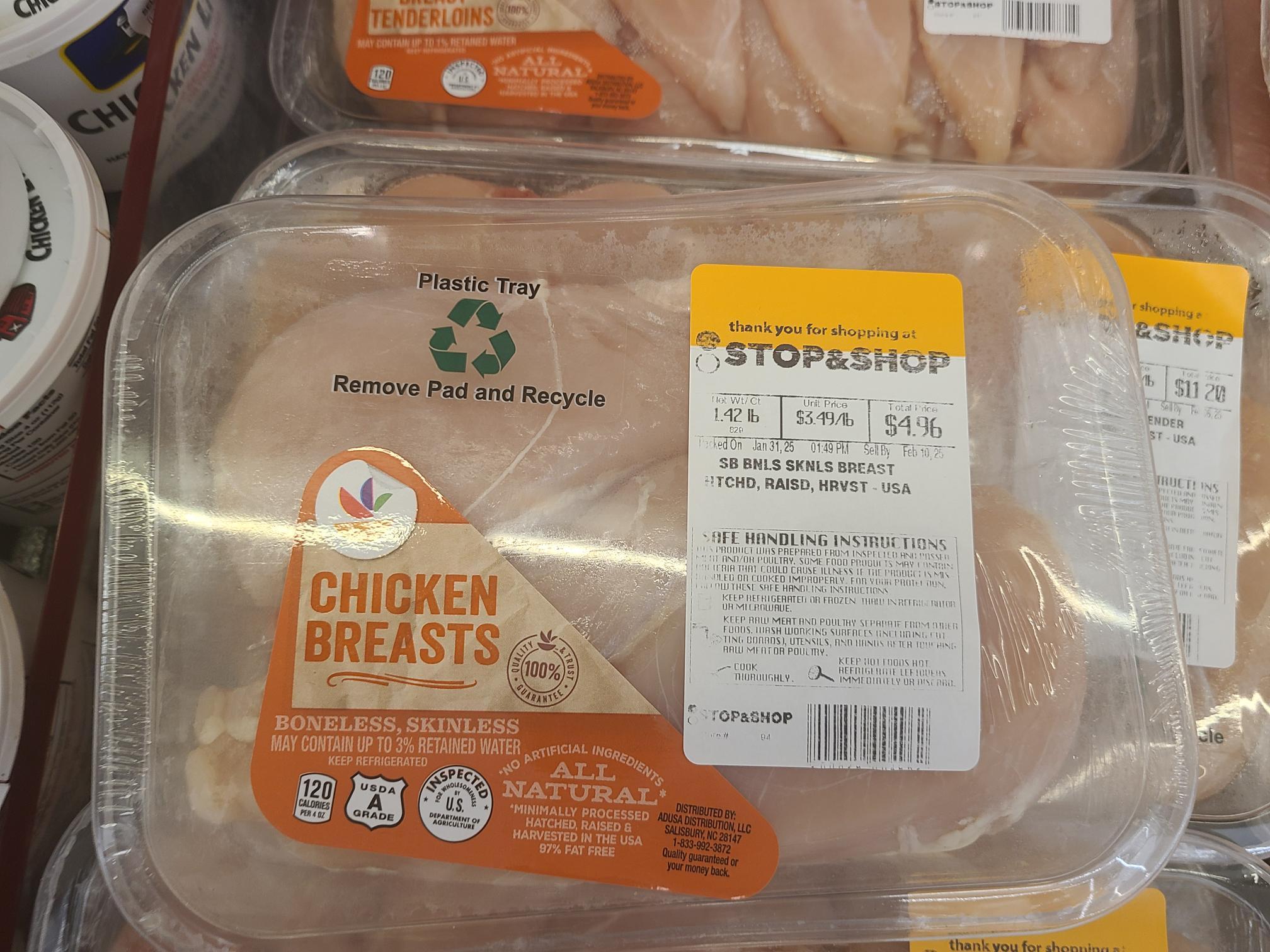
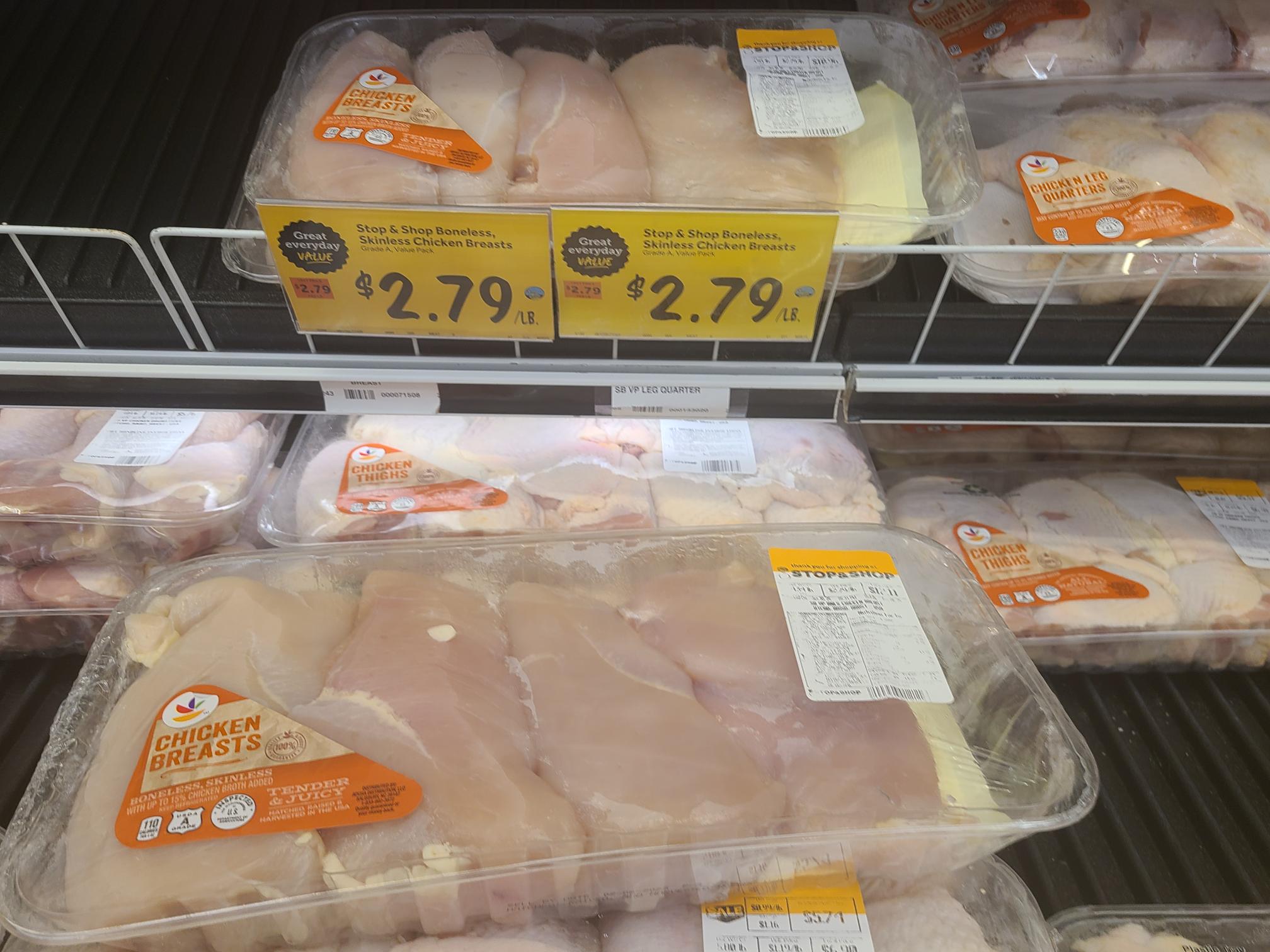
Here is a quick example with chicken breasts. These photos were taken at the same store on the same day. Notice that for a package of two chicken breasts, the price is $3.49 per pound. If you buy a package of four chicken breasts, the price is $2.79 per pound. Suppose one chicken breast is around 0.7lbs. If you need four breasts, buying two packages of two breasts would be \(4\times 0.7 \times 3.49 = \$9.77\text{,}\) and buying the package of four breasts would be \(4\times 0.7 \times 2.79 = \$7.81.\)
Why is this quantity phenomenon the case? There are actually a variety of reasons at play. One component is that buy selling you larger quantities at once, the store is selling more of its product and will likely need to discard as much expired food. So, they pass some of that savings to you. Another component is the hope that you will waste excess food. For example, if you only need three chicken breasts but buy a package of four, they are hoping you will discard that fourth breast rather than freeze and save it for later. There are also a plethora of reasons regarding supply chains and deliver costs. No matter the reasons, also remember the general rule of savings when buying in larger quantities.
There is one issue with buying in bulk. Storage. If you thought to yourself in the chicken example, “but I only need one chicken breast for me,” you are thinking about the chicken you don’t have a plan for. That is a very common thought. To buy in bulk, you need a place to store excess food safely. For shelf-stable products like bottles of ketchup, which can last a long time in a refrigerator, it is easy to store such items. However, for highly-perishable items like chicken, it is less obvious.
The answer is a freezer. A freezer is key to saving money at the grocery store. In fact, I may even recommend looking into a second chest freeze in addition to the freezer in your refrigerator. If you freeze perishable items, such as meats, you can spend much less on groceries over time.
Now, if you had a feeling of disgust at eating chicken that had been put into your freezer, then I am sorry to have to break it to you that the chicken at your supermarket was probably previously frozen already. Unless a product is labeled as “fresh” or “never-frozen,” it was probably frozen. Generally, never-frozen items cost more than the ones that have been frozen. The point is, it is highly recommended to get over the negative reactions to products that have been frozen.
Of course, some things can’t really be frozen, such as lettuce (which is why you’ll never see bags of 10lbs of lettuce at the store). Such items can’t really be bought in bulk.
Subsection 3.2.4 Comparing Prices
Similar to buying in bulk is the concept of comparing prices. Suppose you want to buy Pepsi. A 2-liter bottle is $2.50, but 20oz bottles are on sale for $1.00 each. Which is the better buy? If your math-phobia is starting to kick in, the good news is that most stores will tell you. Kind of.
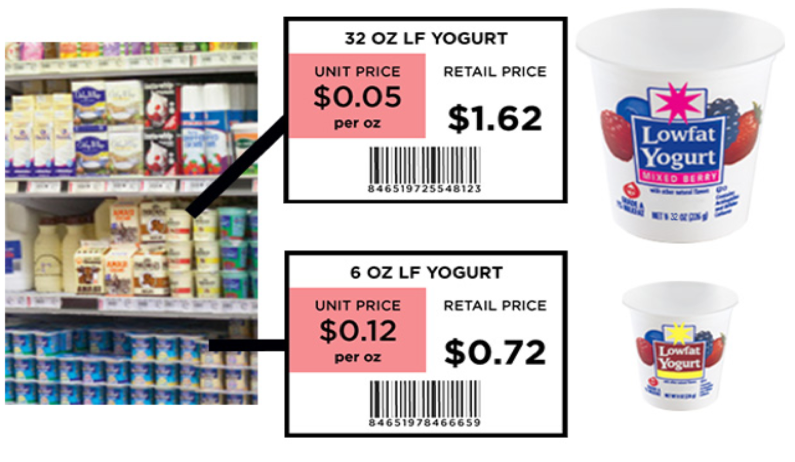
Most price tags at a large supermarket will have multiple numbers on it. Of course, there is the “retail price” - the price you will actually pay. However, there is often a second figure - the “unit price.” The unit price gives you how much you are spending on the product per unit, such as per pound, per ounce, per liter, etc. In fact, in Massachusetts, large retailers are required by law to tell you the per-unit price to help consumers make better decisions.
In the Pepsi example, the answer depends on what the per-unit prices are. If the unit is in fluid ounces, then the 2-liter bottle is about $0.04 per ounce. The 20oz bottles are $0.05 per ounce. So, the 2-liter bottle is consider the better buy.
You should immediately get into the habit of looking at per-unit prices alongside the retail prices. It can help you make clear the price difference among different brands or different quantities. If you are looking to save money, go with the items with lower unit prices. Of course, if you cannot safely store larger quantities, it may not be best to buy in large quantities, even if the per-unit price is better. You never want to waste food, if you can avoid it.
Subsection 3.2.5 Cook Once, Eat a Lot
The number one reason why people go out to eat is to break up the stress and monotony that comes with work and maintaining a family and home day to day. One method for helping with this stress while also saving a great deal of money is to cook for more than one meal at a time. That is, prepare more servings of a meal and save them for later. Learning to use and appreciate leftovers is an excellent money-saving strategy.
For example, if you cook for a family of four, perhaps you could prepare a dinner to feed eight. Use four servings one night and save the other four servings for a night when you are really attempted to take everyone out to a restaurant. If you cook for yourself, you could perhaps prepare a dish meant to serve four and use the extra three servings as lunches to take to work or for dinners later in the week.
Many people are averse to microwaved food. The solution there is to reheat objects in an oven. Yes, it takes longer, but ovens can help maintain the original water distribution in reheated food.
Subsection 3.2.6 Wholesale Clubs
How does the thought of paying $30-$60 per year for the privilege of buying groceries sound? How does the thought of paying $30-$60 per year in order spend only 50%-90%of what you would at a grocery store sound? Until the COVID lockdown, most consumers focused on the first question. In resent years, many people’s minds have maneuvered to the second question. Being a member of a wholesale club can potentially be a way to save a lot of money.
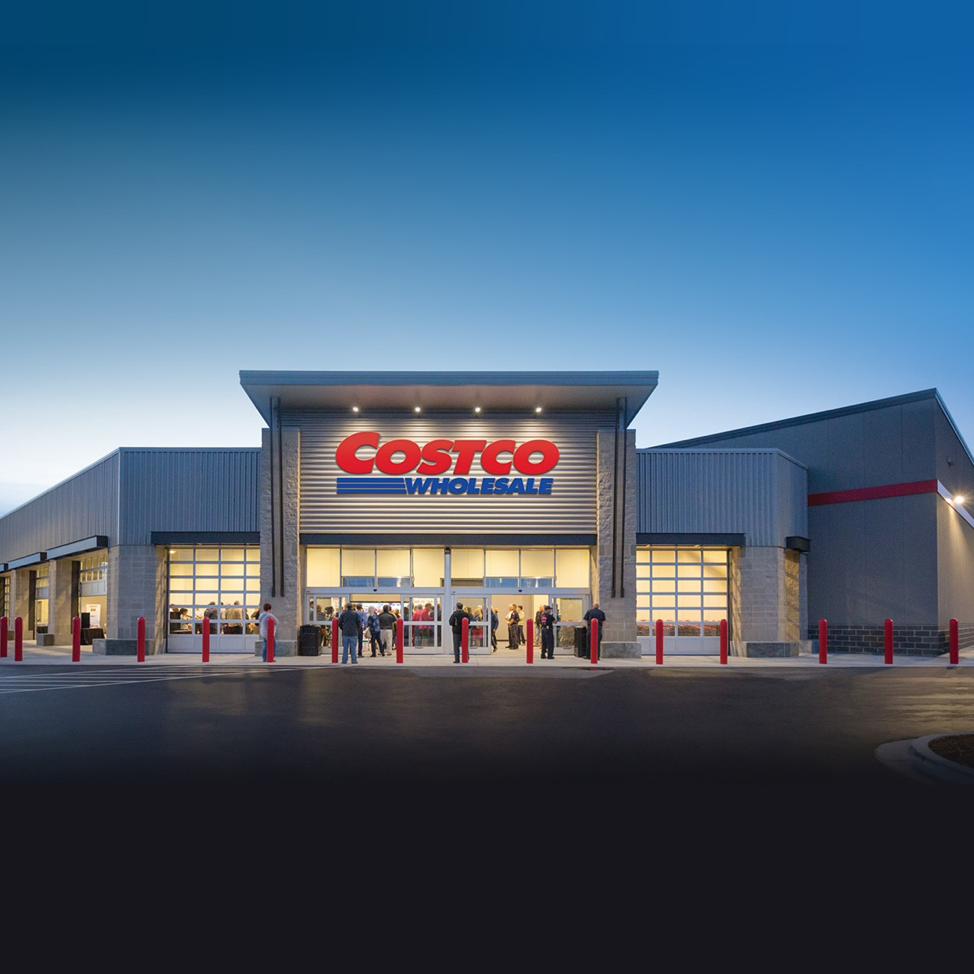
Firstly, “wholesale” refers to the concept of buying a product as it comes from its manufacturer. When you’re in line in a grocery store, do you notice that the candy bars they sell are in a box. The grocery store buys that box “wholesale” from the candy distributer. A wholesale club is a company that purchases whole items and will then sell those items wholesale to consumers for prices at or near what the club pays. So, think of it as being able to buy that box of candy for near the same price the grocery store pays. In essence, a wholesale club is where you can engage in expert mode of buying in bulk.
A wholesale club gets much of its profits through membership fees. Those fees are used to pay employee salaries, invest for company growth, etc. When done right, it’s a surprisingly-stable business model. In our area, the biggest options are B.J.’s, Costco, and Sam’s Club. Although the most expensive, I recommend Costco for a variety of reasons. (How they treat employees, supply-chain robustness, ways to get your membership paid for, etc.)
Just before writing this chapter, I did some reconnaissance. I looked at some unit prices of some common items at the West Springfield Costco and the Stop and Shop next door. The Stop and Shop prices are for the cheapest per-unit price I could find.
| Product | Costco | S S |
| Limes | $0.137/oz | $0.21/oz |
| Cheerios | $0.21/oz | $0.36/oz. |
| Milk Gallon | $3.29/Gal | $4.29/Gal |
| Cage-free Eggs | $3.45/doz | $7.49/doz* |
| Chicken breasts | $2.99/lb | $2.79/lb** |
| New York Steak | $13.99/lb | $16.49/lb |
| Similac Baby Formula | $1.40/oz | $1.77/oz |
*This was at the start of the avian flu outbreak. Costco didn’t price gouge.
**Costco breasts are mostly trimmed. Stop and Shop breasts are untrimmed.
These products are not unique. Generally, items are cheaper at wholesale clubs. Sometimes a little cheaper, sometimes a lot. It doesn’t take long for the membership fee to become more than worth the investment.
There are some downsides to wholesale clubs. First and foremost is the quantity of items. Some items are require a great deal of storage, such as an 18-pack of large paper towel rolls. Shopping at wholesale clubs requires room in your fridge/freezer, pantry, and closets. There is also the membership fee. Many people cannot part with the $30-$60 upfront. They are investments. There is also product rotation. Wholesale clubs make certain arrangements with suppliers. Many products have temporary availability. The last is crowds. People have come to appreciate the prices and supply chains wholesale clubs have. Many locations serve more customers per day than many prefer; they’re not the best places if you’re afraid of crowds.
Subsection 3.2.7 Activity: It Costs Money to Save
Notice that in the four grocery-bill-savings options above, each one requires you to pay more money up front than if you bought on a meal-per-meal basis. This is true in most sectors of our economy. The more money you have available now, the cheaper things will be for you overall. Write a few sentences about how you feel about this fact and why.
Subsection 3.2.8 Alternative-Brand Stores
What’s your reaction if I suggest shopping at Aldi’s? For many people who grew up middle class, it’s one of almost disgust or judgement. It that is you, I would suggest trying to get over that.
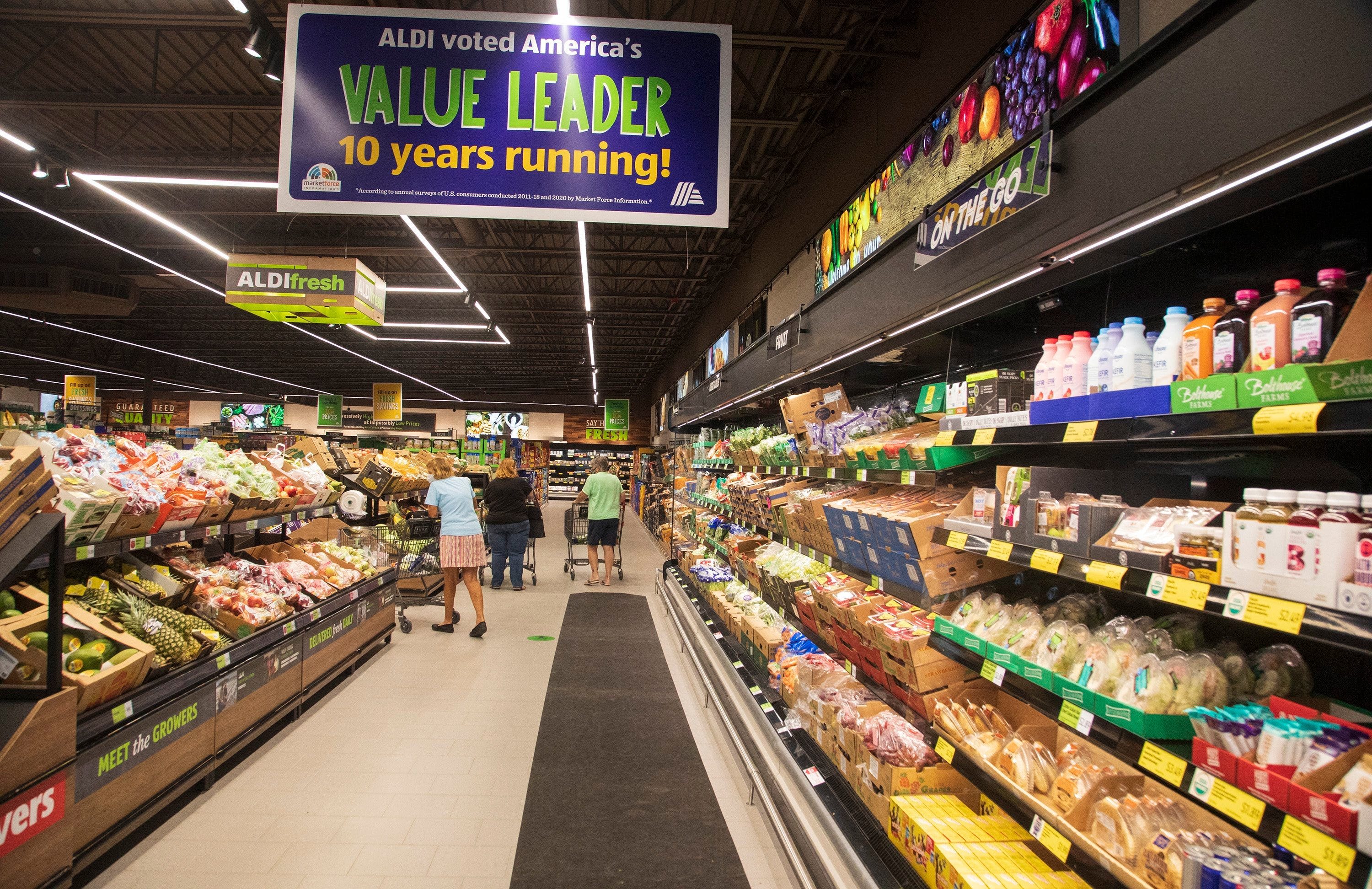
Some stores sell food products from brands that are not sold in major supermarkets. The thing about Americans is that brand recognition is one of the cornerstones of our economy. Do you even know what I’m talking about when I name products like adhesive strips, salicylates, hoop-and-loop fasteners, or personal water crafts? (Band-Aid’s, Aspirin, Velcro, and Jet-Ski. All of them just brands.) We tend not to trust brands we’ve never heard of. (Affinity bias!) It goes a step further. Take produce, which usually isn’t branded. We’re less likely to shop for produce at a place that doesn’t carry the brands on other products that we recognize.
If you can get past your affinity bias, these stores can save you a lot of money. The chain in our region is Aldi’s. There are also independent markets all over the greater Springfield area. Some people might put Trader Joe’s in this category. If you’re having trouble getting over that bias, remember that most of the food that is sold in a place like Aldi’s come from the exact same factories and supplies as those sold in Big Y or Stop and Shop. It really is all down to brand recognition.
Subsection 3.2.9 Shopping the Sales
There is one major point of common misunderstanding about anchoring bias. Because of how sales are advertised, they can trigger our anchoring bias. However, the simple acting of buying an item that is on sale may not necessarily be anchoring bias. If you seeing something marked down causes you to be interested in a product you weren’t interested in before, that is anchoring bias. If there is an item that you buy all the time that goes on sale and you take advantage of the lower price, that isn’t really anchoring bias. It’s a good way to save money.
As you do more and more of your own shopping, you’ll come to know what products you buy regularly. When one of those products goes on sale, it can be a good strategy to “stock up” on that item. For example, I use a lot of chocolate in my baking. I know I’ll use a hefty amount each week. When my usual chocolate bars go on sale, I buy a few week’s worth.
Many people call this strategy “couponing.” It is a good way to save money, but it can be dangerous. Shopping sales can trigger anchoring bias and influence you to buy something you weren’t planning on purchasing. In fact, our local Stop and Shops have tags that look like sales tags that say, “Great value! Stock up now.” Nothing is on sale. They’re trying to trigger your anchoring bias without actually offering any discount.
Subsection 3.2.10 Activity: What Are You Going to Do to Save on Groceries?
Grocery prices are rising, and they’re only going to get worse. Imagine you are an over-worked and underpaid human as most of us are. How are you going to save money on food? Write out a short plan that will implement some of the strategies above. Please don’t just list the above tactics out. Actually think about which of them appeals to you and you see yourself being able to do over the course of your life.

